
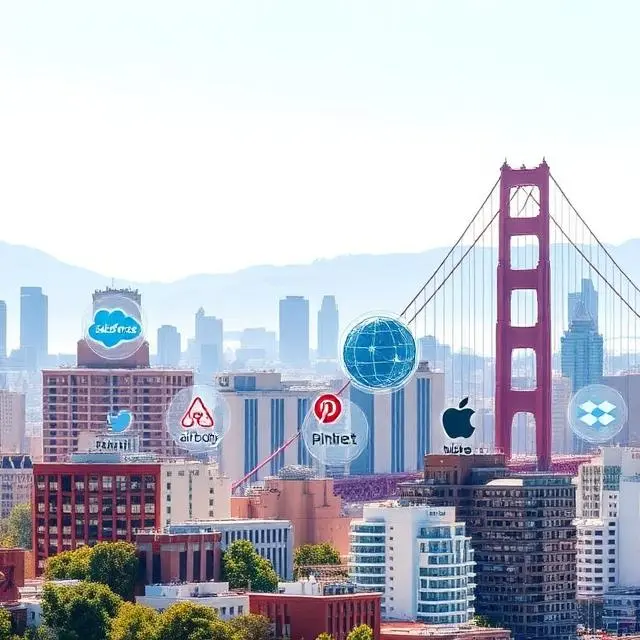
Walk through San Francisco on any given morning. You will see people typing on laptops in coffee shops. You will hear conversations about funding rounds and product launches. You will notice office buildings with names that appear on apps used by hundreds of millions of people worldwide.
This city has a rhythm that feels different from other places. It is hard to explain until you spend time there. But the results speak for themselves.
San Francisco gave the world some of the most recognizable technology companies ever built. These companies changed how people travel, communicate, shop, and work. They started in small apartments and shared offices. They grew into giants that operate in nearly every country on earth.
This article tells that story simply and clearly.
How It All Began
San Francisco has always attracted people who want to build something new.
It started with the Gold Rush in 1849. Thousands of people poured into the city from all over the world. They came with big dreams and very little else. Some struck gold. Most did not. But the culture of taking big risks and betting on yourself became part of the city’s identity from those early days.
Stanford University opened nearby in 1891. This was a turning point. Stanford-trained engineers and scientists. Many of them stayed close after graduating. They started companies instead of moving away. Professors encouraged students to turn their research into real products. Over time a powerful loop formed between the university and the local business world.
By the 1950s the Bay Area was producing serious electronics companies. The 1970s brought personal computers. The 1980s brought software. The 1990s brought the internet. Each new wave built on top of the last one.
When the web exploded in the late 1990s, San Francisco was ready. The talent was already there. The money was already there. The culture was already there. All it needed was a spark.
The Companies That Changed Everything
Salesforce—Started in 1999
Marc Benioff and Parker Harris had a simple idea. Business software did not need to be installed on company computers. It could live on the internet instead. Companies could pay a monthly fee to use it rather than buying expensive programs outright.
Every expert they spoke to told them this idea would fail. They built it anyway.
Salesforce now makes over thirty billion dollars a year. More importantly, it created an entirely new way of selling software. Almost every business software company in the world today uses the model that Salesforce proved could work.
Twitter—Started in 2006
Jack Dorsey, Noah Glass, Biz Stone, and Evan Williams built a platform where anyone could post short public messages. No one quite knew what to call it at first. Within a few years presidents, journalists, and celebrities were using it daily. So we’re ordinary people with things to say.
Twitter changed how news travels. During elections, disasters, and major world events, information now moves through Twitter faster than television can broadcast it. That is a remarkable thing for a platform built around 280 characters.
Airbnb—Started in 2008
Brian Chesky, Joe Gebbia, and Nathan Blecharczyk had no money and a big apartment. When a design conference came to San Francisco and hotels filled up, they rented out air mattresses in their living room to attendees who had nowhere to stay.
That humble beginning turned into the largest hospitality platform on earth. Airbnb lists millions of properties in nearly every country. It gave homeowners a new way to earn income. It gave travelers a new way to experience cities. It made the hotel industry rethink everything.
Uber—Started in 2009
Travis Kalanick and Garrett Camp were standing outside on a cold night in Paris, unable to find a cab. That frustration became a question. What if you could request a car from your phone and pay without cash?
The answer they built disrupted taxi industries in hundreds of cities. It created a new kind of work for millions of drivers. It launched an entire generation of app-based service companies that followed the same model for food, groceries, and home services.
Dropbox—Started in 2007
Drew Houston kept forgetting his USB drive. Files were stuck on whatever computer he happened to be using. He built a simple solution. Store everything online and sync it automatically to every device.
Dropbox made cloud storage feel easy and human. Before Dropbox, most people thought of cloud storage as something complicated and corporate. After Dropbox, it became part of everyday life for ordinary users.
Pinterest—Started in 2010
Ben Silbermann, Paul Sciarra, and Evan Sharp created a platform for collecting images around personal interests. Home design, recipes, fashion, travel, and creative projects found a natural home. Pinterest grew to hundreds of millions of users and became one of the most powerful tools for discovering products and ideas online.
Lyft—Started in 2012
Logan Green and John Zimmer entered the ride-sharing market after Uber and built a competing service with a friendlier personality. Their competition with Uber pushed both companies to improve faster, expand further, and invest more in the driver experience. Without Lyft the ride-sharing industry would have moved slower and improved less.
What Made These Companies Grow?
Several things combined to make San Francisco the right place to build these businesses.
Money was close by. More startup investment money is concentrated in the Bay Area than anywhere else in the world. A founder with a working idea and a clear vision could find an investor meeting within weeks. In most other cities that process takes much longer.
Talented people gathered naturally. Stanford and UC Berkeley produced skilled graduates who stayed nearby. Engineers and designers from all over the world moved to San Francisco because the best opportunities were there. That concentration of talent made hiring easier and collaboration more natural.
Failure was not shameful. In most places a failed business follows an entrepreneur for years. In San Francisco it was treated as an experience. Investors and colleagues asked what you learned rather than writing you off. That attitude encouraged people to try ambitious things they might not have attempted elsewhere.
Everyone was close together. Founders, investors, and engineers all lived and worked within a small area. Important conversations happened at coffee shops and dinner parties. Introductions that led to partnerships and funding relationships happened casually rather than through formal processes.
The Struggles That Came Along the Way
Growth created problems for nearly all of these companies.
Uber faced legal battles in cities that wanted to protect their existing taxi systems. Several governments banned the service before eventually allowing modified versions. The company also dealt with serious internal problems that hurt its public image during important years of growth.
Airbnb fought governments that blamed short-term rentals for making housing less affordable for local residents. Those arguments continue today in major cities around the world.
Twitter spent its entire independent life trying to build a business model that matched its cultural importance. The platform shaped global conversation while struggling financially behind the scenes.
San Francisco itself became a problem for some companies. As costs rose sharply, many workers could no longer afford to live near the office. Some companies moved their headquarters to cities with lower costs and simpler regulations.
What Is Happening Now
Artificial intelligence is driving the next wave of activity in San Francisco right now.
Dozens of companies are building AI tools for healthcare, education, legal work, and creative industries. The energy around these companies feels similar to how people describe the early internet years. Big claims are being made. Large amounts of money are moving. Some of it will produce something genuinely important. Some of it will not.
Remote work has reduced the advantage of being physically located in San Francisco. A founder in another city can now access many of the same networks and investors that once required a Bay Area address.
But the deep connections built over decades do not dissolve quickly. The universities, the experienced founders, the investors, and the culture that produced these companies are still very much present. The next generation of important companies is almost certainly already forming somewhere in the Bay Area.
Conclusion: What This City Proved
San Francisco is not an easy city to live in. Housing is expensive. Daily life is complicated. The problems the city faces are real and serious.
But what it produced over the past several decades is hard to argue with.
Salesforce, Twitter, Airbnb, Uber, Dropbox, Pinterest, and Lyft each started small. Each had a simple idea. Each found the right environment to grow that idea into something the whole world uses.
Their combined impact shows up in daily life for billions of people. The way people find a place to stay when they travel. The way workers earn money. The way news reaches people during a crisis. The way businesses manage their customer relationships. San Francisco left its fingerprints on all of it.
That did not happen by accident. It happened because this city spent decades creating conditions where ambitious people could try big things and sometimes succeed beyond anything they originally imagined.
That is worth understanding. And it is worth remembering the next time someone dismisses a small team in a shared apartment as too small to matter.